
pentax me super instruction manual
The Pentax ME Super, a classic 35mm SLR, boasts a readily available instruction manual in PDF format, aiding users in mastering its features.
What is the Pentax ME Super?
The Pentax ME Super is a 35mm film single-lens reflex (SLR) camera produced by Pentax in the 1980s. It’s renowned for its blend of manual control and convenient automatic features, particularly aperture-priority auto-exposure. A comprehensive instruction manual, often found as a PDF online, details its operation.
This camera is a favorite among film enthusiasts due to its reliability and the quality of images it produces. The manual guides users through everything from loading film to utilizing advanced features, ensuring a smooth photographic experience.
Historical Context & Significance
Released in 1980, the Pentax ME Super arrived during a pivotal shift in camera technology. It bridged the gap between fully manual SLRs and the emerging world of automated photography. The availability of a detailed instruction manual – now commonly a PDF – was crucial for photographers transitioning to its semi-automatic modes.
The ME Super’s significance lies in making sophisticated features accessible. It offered a compelling alternative to Nikon’s offerings, solidifying Pentax’s position as a major player in the film camera market.
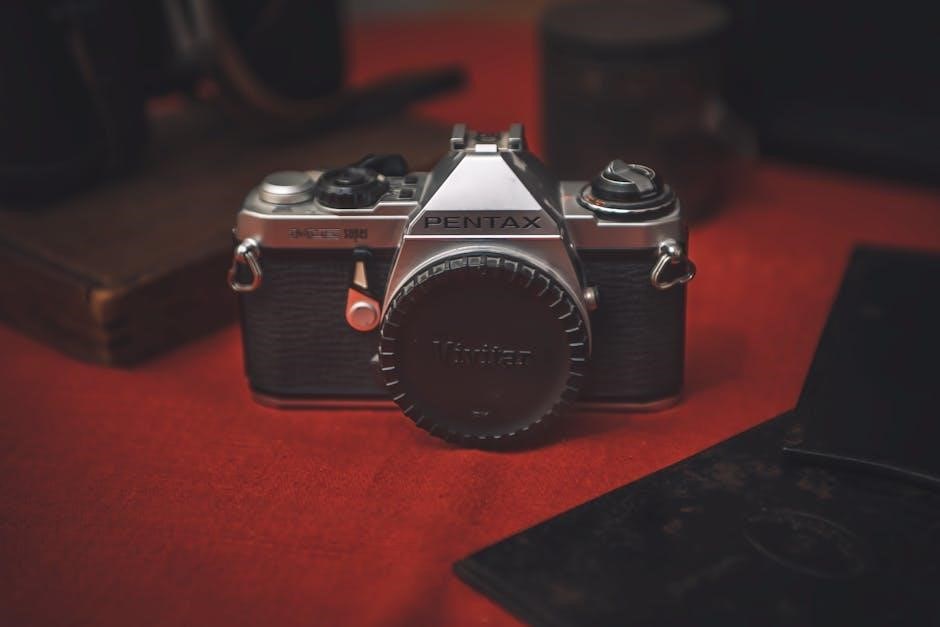
Understanding the Camera Body
The Pentax ME Super’s body houses a robust shutter mechanism and metering system. Refer to the instruction manual for detailed component layouts and functions.
Physical Components & Layout
The Pentax ME Super features a clearly defined layout, as detailed in the instruction manual; Key components include the film advance lever, shutter speed dial, and aperture control. The hot shoe, crucial for flash photography, is prominently positioned. Understanding the location of the film rewind crank and the self-timer button is essential for operation. The manual provides diagrams illustrating each part, aiding in familiarization. Careful study of these diagrams ensures proper handling and prevents accidental adjustments during shooting. The camera’s build quality contributes to its durability.
The Shutter Mechanism Explained
The Pentax ME Super’s shutter mechanism, thoroughly explained in the instruction manual, offers both manual and aperture-priority automatic modes. Shutter speeds range from 2 seconds to 1/1000th of a second, providing versatility. The manual details how to adjust these speeds using the dial. Understanding the relationship between shutter speed and aperture is crucial for correct exposure. The instruction manual emphasizes the importance of a properly functioning shutter for sharp images, and provides guidance on recognizing potential issues.
Metering System Overview
The Pentax ME Super’s center-weighted metering system, detailed in the instruction manual, analyzes light primarily from the center of the frame. This system assists in achieving accurate exposures in various lighting conditions. The manual explains how to interpret the viewfinder’s LED indicators – underexposure, correct exposure, and overexposure. Users learn to utilize exposure compensation when shooting scenes with challenging lighting, like strong backlighting, ensuring properly exposed photographs.

Loading and Unloading Film
The Pentax ME Super manual provides a step-by-step guide for film loading and rewinding, crucial for successful operation of this classic camera.
Film Loading Procedure ⎼ Step-by-Step
Consult the Pentax ME Super manual for detailed instructions, but generally, open the film door via the release lever. Insert the film canister into the left side, ensuring it seats correctly.
Pull the film leader across the camera to the take-up spool on the right. Advance the film and check it catches properly. Close the film door.
The manual emphasizes careful handling to avoid damage and ensures correct film transport. Always refer to the PDF for visual aids and precise steps.
Film Advance and Rewind
The Pentax ME Super’s film advance lever smoothly moves the film forward after each shot. The manual details proper technique for consistent advancement. Rewinding is achieved using the rewind crank on the camera’s top.
The PDF guide stresses gentle, even pressure during rewinding to avoid film tearing. Ensure the film is fully rewound before opening the back to prevent light leaks and damage to the negatives.
Compatible Film Types
The Pentax ME Super is versatile, accepting a wide range of 35mm film types. The instruction manual confirms compatibility with black and white, color negative, and color slide (transparency) films. ISO speeds ranging from 25 to 3200 are supported, though the manual advises checking specific film stock recommendations. Proper film loading, as detailed in the PDF, is crucial for optimal results with any film type.

Exposure Settings & Modes
The Pentax ME Super’s manual details manual and aperture-priority auto modes, offering photographers control over depth of field and shutter speed settings.
Manual Mode: Aperture and Shutter Speed
The Pentax ME Super’s manual thoroughly explains full manual control, requiring photographers to independently set both aperture and shutter speed. Understanding this interplay is crucial for creative control. The manual guides users in selecting appropriate f-stops for depth of field and shutter speeds to freeze or blur motion. It emphasizes the importance of the camera’s metering system as a guide, even in manual mode, to achieve proper exposure. Mastering manual mode unlocks the camera’s full potential, allowing for precise image creation based on artistic vision and lighting conditions.
Automatic (Aperture-Priority) Mode
The Pentax ME Super’s instruction manual details its convenient aperture-priority automatic mode. Here, the photographer selects the desired aperture (f-stop) for depth of field, and the camera automatically chooses the correct shutter speed for proper exposure. The manual stresses monitoring the viewfinder’s LED indicators to confirm a suitable shutter speed is selected, avoiding underexposure or motion blur. This mode simplifies shooting in varied lighting, allowing focus on composition while the camera handles exposure settings efficiently.
Exposure Compensation
The Pentax ME Super instruction manual explains the exposure compensation feature, crucial for tricky lighting scenarios. It allows photographers to override the camera’s metering system, brightening or darkening the image. The manual details using the +/- buttons to adjust exposure, compensating for backlit subjects or scenes with strong highlights/shadows. Correct usage, as outlined, ensures accurate exposures when the camera’s meter is fooled by unusual lighting conditions, preventing washed-out or overly dark photos.
Focusing and Viewfinder
The Pentax ME Super manual details the focusing screen and viewfinder information display, essential for precise focusing and understanding shooting parameters.
Focusing Screen Details
The Pentax ME Super’s focusing screen is crucial for accurate image composition and sharpness. The instruction manual provides details on its features, aiding photographers in understanding how to effectively utilize it. It explains the different markings and aids present on the screen, assisting in precise focusing. Understanding these details allows for better depth of field control and overall image quality. The manual likely illustrates the screen’s layout, clarifying the purpose of each element for both beginners and experienced users. Proper screen utilization is key to maximizing the camera’s potential.
Viewfinder Information Display
The Pentax ME Super’s viewfinder presents essential shooting information directly to the photographer. The instruction manual thoroughly explains each element displayed within the viewfinder, including the aperture setting, shutter speed, and exposure indicators. Understanding these readouts is vital for achieving correct exposure in both manual and aperture-priority modes. The manual likely details how the LED indicators function, signaling over or underexposure. Mastering the viewfinder display ensures confident and accurate shooting, maximizing the camera’s capabilities.
Depth of Field Control
The Pentax ME Super’s instruction manual details depth of field (DoF) control, a crucial aspect of photographic technique. It explains how aperture selection directly impacts the area in focus. Users learn to utilize the depth-of-field scale on the lens, correlating f-stops with focused distances. The manual likely illustrates how to achieve shallow DoF for isolating subjects or extensive DoF for landscapes. Understanding these principles, guided by the manual, empowers photographers to creatively control image sharpness.
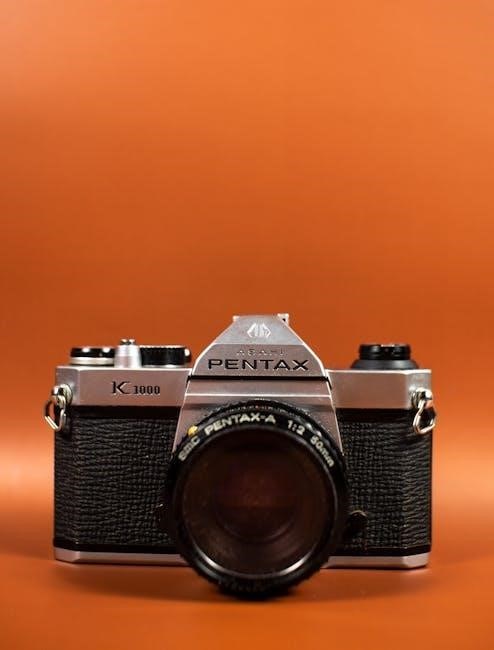
Using Lenses with the Pentax ME Super
The manual clarifies compatibility with Pentax M42 and SMC Pentax-M lenses, alongside guidance on adapting other mounts for expanded photographic possibilities.
Pentax M42 Mount Compatibility
The Pentax ME Super’s instruction manual details its compatibility with the widely-used M42 screw mount lenses. This opens a vast world of vintage glass to users, offering affordable and characterful options. Adapters are readily available, allowing photographers to utilize lenses from various manufacturers originally designed for the M42 system. The manual likely provides guidance on proper adapter selection and potential limitations when using adapted lenses, ensuring optimal performance and avoiding damage to the camera or lens. Understanding the nuances of M42 mounting is key to unlocking the full potential of the ME Super.
SMC Pentax-M Lenses
The Pentax ME Super instruction manual emphasizes the benefits of using SMC Pentax-M lenses. These lenses, designed specifically for the Pentax M42 mount, deliver superior optical quality and performance when paired with the camera. “SMC” denotes Super Multi-Coating, reducing flare and enhancing contrast. The manual likely details the range of available SMC Pentax-M lenses, their specifications, and optimal usage scenarios. Utilizing these lenses ensures compatibility and unlocks the camera’s full potential, providing sharp, vibrant images.
Adapting Other Lens Mounts
While the Pentax ME Super natively uses the M42 screw mount, the instruction manual doesn’t directly address adapting other lens mounts. However, users frequently employ adapters to utilize lenses from different systems. These adapters allow mounting lenses with different bayonet or screw thread patterns. Successful adaptation requires careful selection and understanding of potential limitations, such as reduced functionality or focusing issues. Researching compatible adapters and their specific requirements is crucial for optimal results.
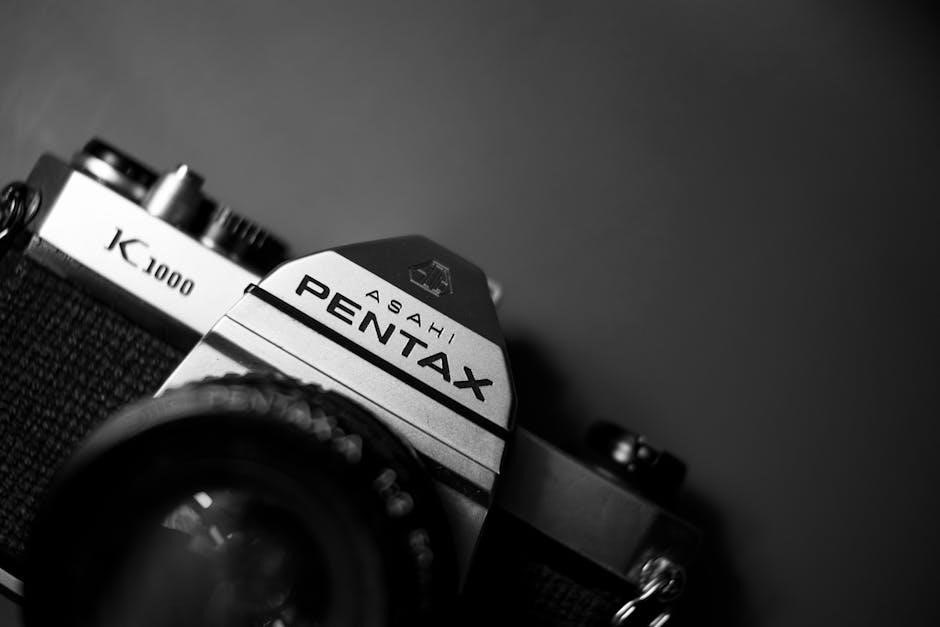
Hot Shoe and Flash Photography
The Pentax ME Super’s hot shoe facilitates external flash use, but the manual cautions about preserving the delicate metal contacts to avoid costly repairs.
Hot Shoe Functionality
The Pentax ME Super’s hot shoe enables convenient connection of external flash units for enhanced lighting control. It’s crucial to handle this component with care, as the metal contacts are prone to damage due to the camera’s age. Replacing these contacts can be difficult and expensive. The hot shoe allows for off-camera flash synchronization, expanding creative possibilities. Always ensure a secure connection before operation to avoid interruptions during photography. Protecting these contacts is vital for continued functionality.
Flash Synchronization Speed
Understanding the Pentax ME Super’s flash synchronization speed is key to avoiding dark bands in your images. This camera typically synchronizes with electronic flash at 1/60th of a second. Exceeding this speed will result in a portion of the image being unexposed, creating unwanted shadows. Utilizing slower shutter speeds ensures full illumination when employing flash photography. Refer to the manual for precise details and optimal flash settings for various shooting scenarios.
Using External Flash Units
The Pentax ME Super’s hot shoe facilitates connection with external flash units for enhanced lighting control. Ensure the flash unit is properly seated and synchronized to the camera’s flash sync speed (typically 1/60th second). The manual details how to adjust flash exposure compensation for optimal results. Be mindful of the hot shoe contacts; they can be delicate and potentially difficult to replace, as parts for this older camera are scarce.

Maintenance and Troubleshooting
Regular cleaning and addressing common issues, like hot shoe contact problems, are crucial for maintaining the Pentax ME Super’s functionality, as detailed in the manual.
Cleaning the Camera Body
Maintaining the Pentax ME Super’s body requires gentle care. The instruction manual doesn’t detail specifics, but a soft, dry cloth is ideal for removing dust. Avoid liquids or abrasive cleaners, which could damage the finish. Pay particular attention to the viewfinder window and film chamber. Carefully dust the shutter curtain area, being extremely cautious not to scratch it. Regular, gentle cleaning prevents buildup and ensures optimal operation of this classic camera, preserving its aesthetic appeal and functionality for years to come.
Common Issues and Solutions
The Pentax ME Super, while robust, can exhibit age-related issues. A frequent concern involves the hot shoe contacts, potentially requiring costly repair or replacement as parts are scarce. The instruction manual doesn’t cover repairs. Light meter inaccuracies can occur; professional servicing is recommended. Sticky shutter speeds might necessitate a CLA (Clean, Lubricate, and Adjust). Always prioritize professional help for internal repairs to avoid further damage to this valuable vintage camera.
Hot Shoe Contact Concerns & Repair
The Pentax ME Super’s hot shoe contacts are prone to corrosion and damage over time. Losing these metal contacts is a significant issue, as replacements are difficult to source and expensive. The instruction manual offers no guidance on repair. Careful handling is crucial; avoid excessive force when attaching/detaching flashes. If contacts are missing or damaged, professional repair is generally the only viable solution due to their specialized nature and scarcity.
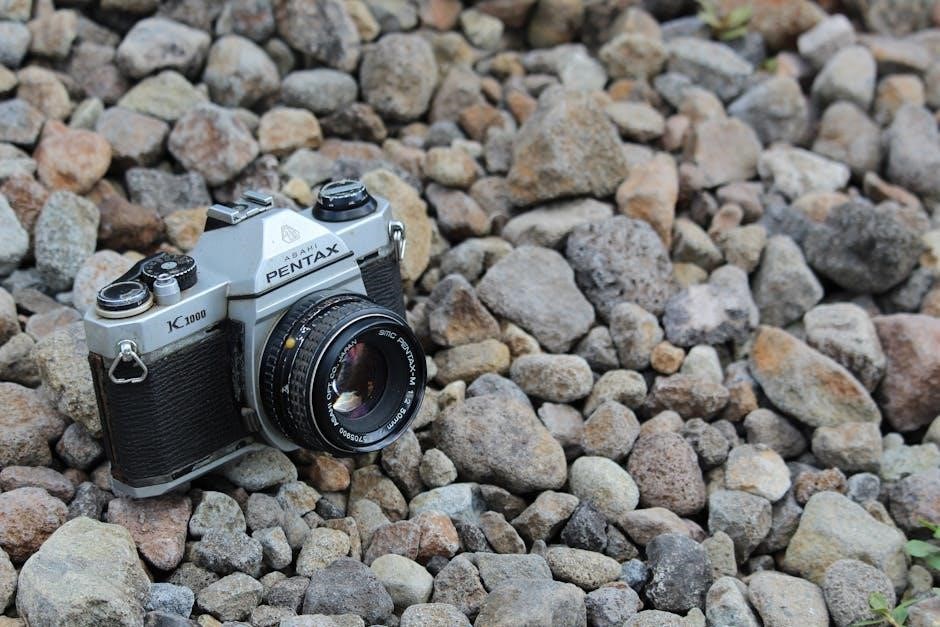
Advanced Features & Techniques
The Pentax ME Super instruction manual details multiple exposure capabilities, self-timer operation, and filter usage for creative photographic control.
Multiple Exposure Capabilities
The Pentax ME Super’s instruction manual guides users through creating multiple exposures, a technique allowing several images to be combined onto a single frame. This is achieved by utilizing the manual shutter release and re-cocking the shutter without advancing the film. Careful consideration of exposure is crucial, as each image adds to the overall brightness. The manual details how to prevent accidental film advance during this process, ensuring successful and artistic layered photographs. Experimentation with different combinations unlocks unique creative possibilities, offering a distinctive aesthetic beyond standard single-image capture.
Self-Timer Operation
The Pentax ME Super’s instruction manual clearly explains its self-timer function, enabling delayed shutter release for self-portraits or group photos. Activation involves setting the timer lever to the desired delay – typically around 10 seconds. Once activated, the shutter releases automatically after the set time. The manual emphasizes ensuring the camera is stable during the delay to avoid blurry images. It also cautions against accidentally bumping the camera, potentially interrupting the self-timer sequence and ruining the shot.
Using Filters
The Pentax ME Super instruction manual details filter usage, highlighting compatibility with standard screw-in filters. These filters enhance images through effects like polarization, UV protection, or color correction. The manual specifies the filter thread size for SMC Pentax-M lenses, ensuring proper fit. It advises careful attachment to avoid damage and suggests experimenting with different filters to achieve desired creative results. Proper filter selection, as outlined, significantly expands photographic possibilities.

Comparing the Pentax ME Super
The Pentax ME Super instruction manual aids comparison; it has fewer modes than the Nikon FA, offering manual and aperture-priority auto exposure options.
Pentax ME Super vs. Nikon FA
Comparing the Pentax ME Super and Nikon FA reveals key differences, often clarified within the ME Super’s instruction manual. The Nikon FA presents a broader range of shooting modes, while the Pentax ME Super focuses on simplicity with manual and aperture-priority auto modes.
Understanding the ME Super’s manual is crucial, as it details its streamlined operation. Though fewer modes are available, the ME Super delivers excellent image quality. The Nikon FA’s complexity might overwhelm some, making the ME Super’s focused approach appealing, especially for those prioritizing a direct connection to exposure settings.
Strengths and Weaknesses
The Pentax ME Super, as detailed in its instruction manual, excels in its user-friendly design and reliable performance. A key strength is its aperture-priority auto mode, simplifying exposure control. However, it lacks the extensive feature set of some contemporaries.
Weaknesses include potential hot shoe contact issues, requiring careful maintenance – information found within the manual. While adaptable to various lenses, finding replacement parts can be costly. Overall, the ME Super offers a compelling blend of simplicity and quality for film enthusiasts.
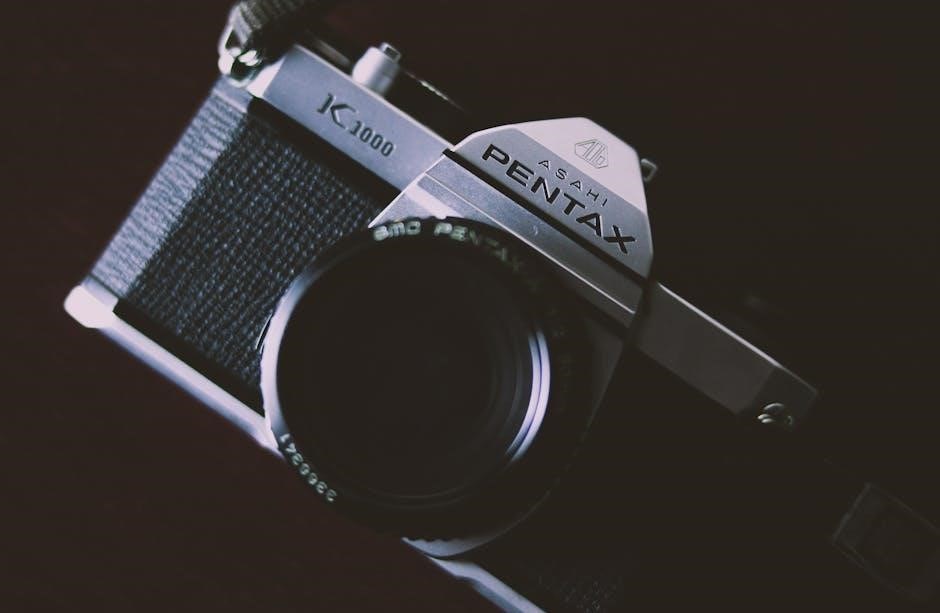
Resources and Further Information
A PDF version of the Pentax ME Super instruction manual is easily accessible online, alongside vibrant communities and repair services for assistance.
Where to Find the Manual (PDF)
Locating the Pentax ME Super’s manual in PDF format is straightforward. Several websites archive vintage camera documentation, offering free downloads; A key instruction is to “RIGHT CLICK ON LINK BELOW, CHOOSE SAVE TARGET AS” to ensure proper saving.
Be mindful of potential issues opening or printing these older files; troubleshooting guidance is often provided on the same sites.
For a printed and bound copy, external companies offer this service for a fee, providing a physical manual for convenient reference during shooting.
Online Communities and Forums
Numerous online communities cater to Pentax enthusiasts and vintage camera users. These forums are invaluable resources for troubleshooting, sharing experiences, and seeking advice regarding the ME Super.
Users frequently discuss the instruction manual, offering interpretations and solutions to common questions.
These platforms provide a collaborative environment where owners can connect, exchange knowledge, and find support for maintaining and operating their classic Pentax cameras effectively.
Repair Services
While the instruction manual aids in basic maintenance, complex repairs often require professional assistance. Several specialized repair services focus on vintage film cameras like the Pentax ME Super.
Finding a technician familiar with these older models is crucial, especially concerning delicate components like the hot shoe contacts, which can be costly to replace.
These services can address issues not covered in the manual, ensuring the camera’s continued functionality and preserving its value.